
The Quick Version
- Help is free and 24/7: call 1-800-799-7233, text START to 88788, or chat live at thehotline.org.
- In CDC’s 2016/2017 survey report (released 2022), 53.6% of Black women reported physical or sexual violence or stalking by a partner.
- Abuse is not only physical. Controlling your money, tracking your phone and cutting you off from family are warning signs too.
- In immediate danger, call 911. For a suicide, mental health or emotional crisis, call or text 988.
October is Domestic Violence Awareness Month, and the 2026 national campaign carries a simple promise: “With Survivors, Always.” The Domestic Violence Awareness Project, run by the National Resource Center on Domestic Violence, says this year’s focus is action, because survivors deserve more than awareness posts. That is a fitting message for Black families, who carry some of the heaviest weight of this issue and often have the fewest places to set it down.
This guide is built to be useful, not heavy. You will find the numbers that matter, the warning signs people miss (especially around money and phones), how to show up for a friend, safety planning basics and resources made with our community in mind. If you are reading this for yourself, you are not overreacting, and you are not alone.
Domestic Violence Awareness Month by the numbers
The need is steady and it is daily. In a one-day count on Sept. 10, 2025, local domestic violence programs served 84,146 victims, according to the National Network to End Domestic Violence. On that same day, programs could not meet 13,018 requests for help because they lacked resources, and 58% of those unmet requests were for housing and shelter.
The newest national data from the CDC’s National Intimate Partner and Sexual Violence Survey, a data brief published in February 2026 covering 2023 and 2024, found that more than 1 in 3 U.S. women (34.0%) have experienced contact sexual violence, physical violence and/or stalking by an intimate partner. Nearly 1 in 3 women (30.2%) reported psychological aggression, which includes insults, threats and controlling behavior.
That brief does not break results out by race. The most recent CDC report that does, the 2016/2017 intimate partner violence report released in 2022, found that 53.6% of non-Hispanic Black women and 57.6% of non-Hispanic Black men reported contact sexual violence, physical violence and/or stalking by a partner in their lifetime. Because these come from different survey cycles, compare them with care. The takeaway is the same either way: this touches a large share of our families, including men.
Warning signs, including money and phones
The National Domestic Violence Hotline lists warning signs of abuse that include a partner who:
- Tells you that you never do anything right
- Gets extremely jealous of your friends or discourages time with family
- Insults or shames you, especially in front of other people
- Keeps you from making your own decisions, including about work or school
- Controls household money without discussion
- Threatens to hurt or take away your children or pets
- Destroys your belongings or intimidates you with threats or weapons
The Hotline notes that even one or two of these behaviors is a red flag.
Financial abuse is one of the most common and least discussed forms. The NNEDV says financial abuse occurs in 99% of domestic violence cases, and it is a major reason survivors stay or return. It can look like an allowance you did not agree to, a partner taking your paycheck or benefits, or someone making you late so you lose your job. If you are rebuilding your finances, our Q4 money checklist for Black families can help you get organized.
Digital abuse is just as real. The Hotline’s guide to technology-facilitated abuse describes location tracking through apps or hidden GPS devices, spyware on phones, monitoring your social media, nonstop texting and threats to share intimate images. Smart home devices, like digital door locks and smart speakers, can be misused too.
One practical tool: the Safe Connections Act of 2022 lets survivors separate their phone line from a shared wireless plan with an abusive partner. According to the Hotline, carriers must complete the separation within two business days, and you will need documentation such as a signed statement from a provider or advocate, a police report or a protective order.
How to help a friend
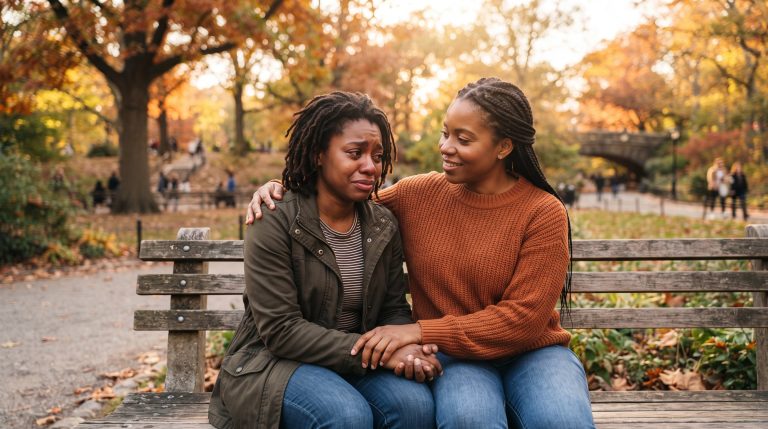
Most of us will be the person someone trusts before we are ever the person who needs help. The Office on Women’s Health offers clear guidance for helping a friend, and the heart of it is this: stay close, and do not push.
Screenshot this: How to show up for someone
- Pick a private moment, ideally in person, with no distractions.
- Name what you have noticed, calmly and specifically. Say you are worried about their safety.
- Listen. Believe them. Tell them it is not their fault and they are not alone.
- Do not say “just leave.” Leaving is a process, and the decision is theirs.
- Offer something concrete: a ride, childcare, a safe place to keep a bag.
- Share the Hotline: 1-800-799-7233, text START to 88788, or chat at thehotline.org.
- If they stay or go back, keep showing up. Your steady presence matters.
Also take care of yourself. Supporting someone through abuse is emotionally heavy, and it is okay to talk to someone about how it is affecting you.
Safety planning basics
A safety plan is a personal, practical plan to improve your safety while you are in a relationship, while you prepare to leave or after you leave. The Hotline offers a free interactive safety planning tool that helps you build a personalized plan for your situation. Its advocates are also available 24/7 by phone or chat to help create one with you.
A few basics most plans include:
- A code word that tells trusted friends or family you need help
- A safe place to go and a way to get there
- A bag with essentials kept somewhere safe, or with someone you trust
- A plan for children and pets
- Safer ways to go online. The Hotline suggests regularly clearing your browser history, and you can leave its site quickly by pressing Escape twice.
If an abuser may be watching your devices, use a phone or computer they cannot access, like a friend’s or one at a library, when you look for help.
Resources made with us in mind
Culturally specific support matters. For more than two decades, the Institute on Domestic Violence in the African American Community (IDVAAC) was a national resource for Black survivors. Founded in 1993, it closed in 2016, and Ujima, Inc. formed to continue the work, according to the Battered Women’s Justice Project.
Ujima, The National Center on Violence Against Women in the Black Community, works to end domestic, sexual and community violence affecting Black women and girls. It is a national resource center rather than a crisis line, offering training, research and resources for survivors, service providers and community members. For immediate help, its site points to the National Domestic Violence Hotline. If you are looking for a counselor who understands your experience, our guide to finding a Black therapist, including low-cost options is a good next step.
Save these numbers
- National Domestic Violence Hotline: call 1-800-799-SAFE (7233), text START to 88788, or chat live at thehotline.org. Spanish is available.
- 988 Suicide and Crisis Lifeline: call or text 988, or chat online. The 988 Lifeline is free, confidential and available 24/7.
- For teens and young adults: love is respect at 866-331-9474, or text LOVEIS to 22522.
- In immediate danger: call 911.
What action looks like this October
“With Survivors, Always” is a call to act, and you do not need a title to answer it. Save the Hotline number in your phone. Check on the friend who has gone quiet. Ask your church, sorority, fraternity or barbershop to post the numbers where people can see them. Donate to or volunteer with a local domestic violence program, since the one-day count shows how many requests go unmet.
And if this is your story, a trained Hotline advocate can help you think through options at your own pace, with no judgment and no pressure to leave before you are ready. You deserve to be safe, and you deserve support getting there.